(Finally making an extra effort to write more entries.)
I visited the Van Gogh Museum in Amsterdam yesterday, and just wanted to do a little show-and-tell of the paintings most memorable to me, because I think they're worth sharing. Lately, I've been motivated to understand more about art--not just to learn about it, but to form opinions about it on my own, without reading the little placards and background information. So, going to an actual museum and witnessing the paintings firsthand is usually quite the workout for my brain.
This is the only painting of Van Gogh's that makes me feel calm. I guess I could be technical and say, it has less of those vigorous little brushstroke lines and dots that he's so famous for, but I'd rather say it's an intangible overall feeling of peace that he exudes through his drawing. Then I read the placard and found out that he drew this to depict that the bedroom is a place of peace and rest.
I didn't like this painting from the first moment I saw it on posters in the gift shop, and I couldn't figure out why. Later I realized that it made me feel lonely. I think proportions are a big thing to notice in Van Gogh, and it's interesting how he (intentionally or unintentionally) uses unusual proportions to exude emotion. This painting strikes me as...so so so lonely. Looking at it immediately saddened me. Especially that little red patch all by itself in the bottom middle. (Is it a coincidence that Van Gogh was a redhead? Hm.)
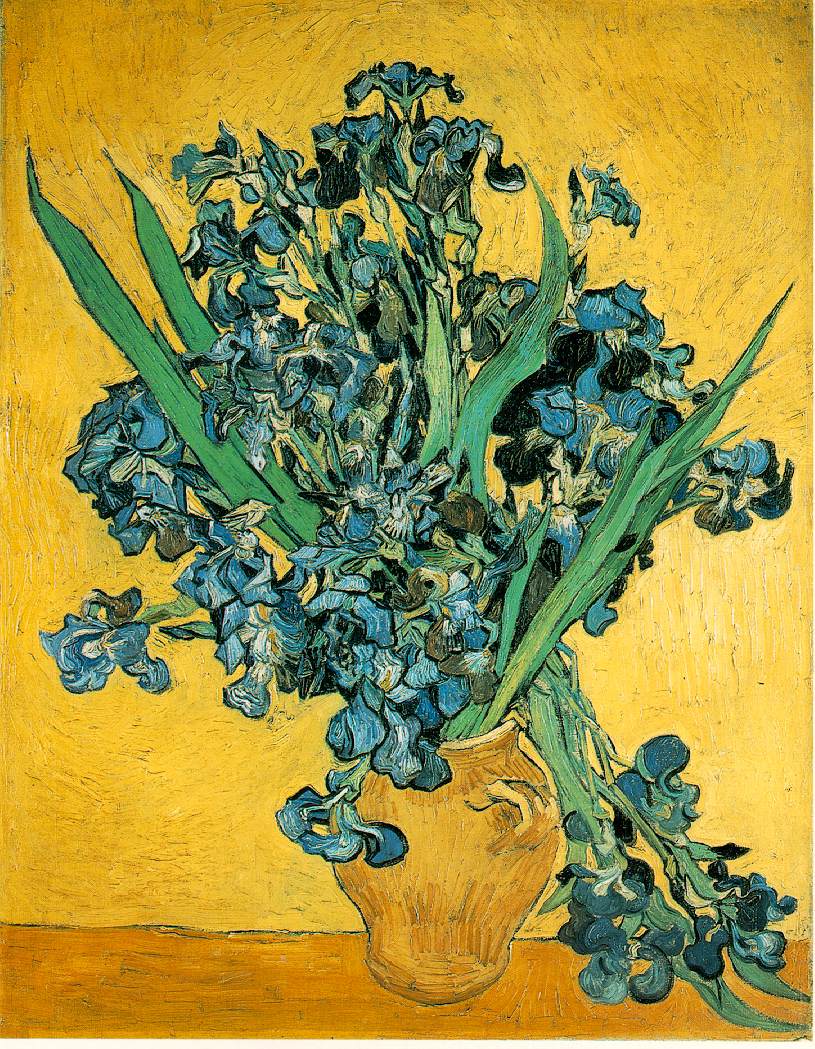
Maybe my favorite painting I saw yesterday, not only because irises are my favorite flower, but also because Van Gogh said that he wanted to demonstrate the way opposite colors strengthen each other when they are combined. So simple and wise. :)
My sister's favorite. :) I love the unabashedly bold signature in red.
Just an example of what is "typical" of Van Gogh's paintings...there is so much going on, it almost makes my head hurt. A lot of paint piled and squeezed right onto the surface, so that it's almost like half-sculpture, half-painting. A lot of MOVEMENT, and overwhelming feeling. There's an inhuman, tumultuous amount of emotion he's trying to express all at once. I really don't think a sane man could have created something like this.
Saturday, July 28, 2012
Tuesday, July 24, 2012
Anna Karenina
My favorite part:
"Wait," he said, sitting down at the table. "There's one thing I've long wanted to ask you."
He looked straight into her tender though frightened eyes.
"Please do."
"Here," he said, and wrote the initial letters: w, y, a, m: t, c, b, d, i, m, n, o, t? These letters meant: "When you answered me: 'that cannot be', did it mean never or then?" There was no likelihood that she would be able to understand this complex phrase, but he watched her with such a look as if his life depended on her understanding these words.
She glanced at him seriously, then leaned her knitted brow on her hand and began to read. Occasionally she glanced at him, asking with her glance: "Is this what I think?"
"I understand," she said, blushing.
"What is this word?" he said, pointing to the n that signified the word never.
"That means the word never," she said, "but it's not true!"
He quickly erased what was written, gave her the chalk and got up. She wrote: t, I, c, g, n, o, a.
...He suddenly beamed: he had understood. It meant: "Then I could give no other answer."
He glanced at her questioningly, timidly.
"Only then?"
"Yes," her smile replied.
"And n...And now?" he asked.
"Well, here, read this. I'll tell you what I would wish. Would wish very much!" She wrote the initial letters: t, y, c, f, a, f, w, h. It meant,: "that you could forgive and forget what happened."
He seized the chalk with his tense, trembling fingers and, breaking it, wrote the initial letters of the following: "I have nothing to forgive and forget, I have never stopped loving you."
She glanced at him, the smile staying on her lips.
"I understand," she said in a whisper.
"Wait," he said, sitting down at the table. "There's one thing I've long wanted to ask you."
He looked straight into her tender though frightened eyes.
"Please do."
"Here," he said, and wrote the initial letters: w, y, a, m: t, c, b, d, i, m, n, o, t? These letters meant: "When you answered me: 'that cannot be', did it mean never or then?" There was no likelihood that she would be able to understand this complex phrase, but he watched her with such a look as if his life depended on her understanding these words.
She glanced at him seriously, then leaned her knitted brow on her hand and began to read. Occasionally she glanced at him, asking with her glance: "Is this what I think?"
"I understand," she said, blushing.
"What is this word?" he said, pointing to the n that signified the word never.
"That means the word never," she said, "but it's not true!"
He quickly erased what was written, gave her the chalk and got up. She wrote: t, I, c, g, n, o, a.
...He suddenly beamed: he had understood. It meant: "Then I could give no other answer."
He glanced at her questioningly, timidly.
"Only then?"
"Yes," her smile replied.
"And n...And now?" he asked.
"Well, here, read this. I'll tell you what I would wish. Would wish very much!" She wrote the initial letters: t, y, c, f, a, f, w, h. It meant,: "that you could forgive and forget what happened."
He seized the chalk with his tense, trembling fingers and, breaking it, wrote the initial letters of the following: "I have nothing to forgive and forget, I have never stopped loving you."
She glanced at him, the smile staying on her lips.
"I understand," she said in a whisper.
Saturday, July 7, 2012
Home Videos
I think everyone goes through two stages of puberty--the famous first being the teenage years of physical growth, emotional turmoil, and self-definition...and the less frequently mentioned but, in my opinion, just as significant, being these nebulous years between going off to college and becoming independently financially stable. Physically, you're in that weird transition between dealing with both pimples and wrinkles...wanting to celebrate your youth by pulling all-nighters, sky-diving, working out etc. but also feeling alarmingly sore after a simple airplane ride, getting creaky bones when it rains, forgetting basic things (like your dad's Chinese name, or your sister's age)... Socially, you're stuck between the Adult Table and Kiddie Table at family friend gatherings. Do you join the adults, who are talking about subjects with which you can keep up, but are unfortunately being discussed in Chinese? Or do you join the kids, exuding adolescence awkwardness brought on by high school stresses and middle school dramas? Financially, you're utterly confused. When you're at college, you make generally all decisions about where/how to spend your money--groceries, travel tickets, clothes--and finally with your own credit/debit card, you have the freedom to buy secret presents for your parents that really will be secret. At the same time, you can't fool anyone: it's still your parents' money, and will be for a while, until you've had a job long enough to fully support yourself. And until then, as much as you feel entitled to, you can't justifiably INSIST on anything from your parents...not really. And emotionally, it's just another ongoing stage of discovering that vaguely specific answer of who you want to be.
At least this is how I feel right now.
There's also a point that maybe everyone reaches at one time or another, when you're at home with your parents (maybe on a break from college), and you start thinking, this doesn't feel as "right" as it used to. Being nagged at about sleeping early enough, not talking on the phone for too long, and eating fruit just seems ridiculous at this age, especially after having survived out in the world (of college) on your own. I've started to experience little snatches of these moments, when I think I'd choose being on my own over being with my family. It's SO bizarre. At the same time, I also start feeling little snatches of moments where it's now my responsibility to take care of them, instead of the other way around. Roles are constantly being switched around, where one moment it's my mom or dad yelling at me to hurry up and take a shower before it's too late, and the next moment I'm lecturing them about keeping the kitchen area clean or whatever.
But then there are the days when things are back to normal. The last 2 days when I got home in the evening, my parents and sister were sitting in the family room around the TV, with miscellaneous snacks on the sofa, telling riddles, my dad trying to outsmart us with sadly unsuccessful trick questions, my mom in a hyper state of continual laughter, my sister propping her giant feet on the table and promptly knocking over 3 or 4 things. And though I had a bunch of things to do before I could relax for the night, all I wanted to do was plop down next to them and just...be with them.
I woke up at 3:50am today to take them to the airport. When I got home, I couldn't fall back asleep, so I dug out some old video tapes that my parents took from before I was born. It's amazing to watch my mom and dad before they had kids. There were also some scenes of my grandparents visiting when my parents got their house in San Jose. I think I got my habit of harboring and talking to a multitude of stuffed animal from my grandma. And I think I got my persistence and silent/constant interest in food from my grandpa.
So, so happy that we have these videos. I'm such a firm believer in keeping a record of everything, whether it's through words or pictures, audio or visual. Happy happy happy. :)
At least this is how I feel right now.
There's also a point that maybe everyone reaches at one time or another, when you're at home with your parents (maybe on a break from college), and you start thinking, this doesn't feel as "right" as it used to. Being nagged at about sleeping early enough, not talking on the phone for too long, and eating fruit just seems ridiculous at this age, especially after having survived out in the world (of college) on your own. I've started to experience little snatches of these moments, when I think I'd choose being on my own over being with my family. It's SO bizarre. At the same time, I also start feeling little snatches of moments where it's now my responsibility to take care of them, instead of the other way around. Roles are constantly being switched around, where one moment it's my mom or dad yelling at me to hurry up and take a shower before it's too late, and the next moment I'm lecturing them about keeping the kitchen area clean or whatever.
But then there are the days when things are back to normal. The last 2 days when I got home in the evening, my parents and sister were sitting in the family room around the TV, with miscellaneous snacks on the sofa, telling riddles, my dad trying to outsmart us with sadly unsuccessful trick questions, my mom in a hyper state of continual laughter, my sister propping her giant feet on the table and promptly knocking over 3 or 4 things. And though I had a bunch of things to do before I could relax for the night, all I wanted to do was plop down next to them and just...be with them.
I woke up at 3:50am today to take them to the airport. When I got home, I couldn't fall back asleep, so I dug out some old video tapes that my parents took from before I was born. It's amazing to watch my mom and dad before they had kids. There were also some scenes of my grandparents visiting when my parents got their house in San Jose. I think I got my habit of harboring and talking to a multitude of stuffed animal from my grandma. And I think I got my persistence and silent/constant interest in food from my grandpa.
So, so happy that we have these videos. I'm such a firm believer in keeping a record of everything, whether it's through words or pictures, audio or visual. Happy happy happy. :)
Monday, June 25, 2012
Wisdom
Middlemarch Quote #6: A true love for a good woman is a great thing...it shapes many a rough fellow.
Middlemarch Quote #7: ...after a little pause, she said, more gravely, bending her face before her father's, "If you are contented with Fred?"
Caleb screwed up his mouth and turned his head aside wisely.
"Now, father, you did praise him last Wednesday. You said he had an uncommon notion of stock, and a good eye for things."
"Did I?" said Caleb, rather slyly.
"Yes, I put it all down, and the date, anno Domini, and everything," said Mary. "You like things to be neatly booked. And then his behavior to you, father, is really good; he has a deep respect for you; and it is impossible to have a better temper than Fred has."
"Ay, ay; you want to coax me into thinking him a fine match."
"No, indeed, father. I don't love him because he is a fine match."
"What for, then?"
"Oh, dear, because I have always loved him. I should never like scolding any one else so well; and that is a point to be thought of in a husband."
Elinor Dashwood now has Mary Garth as a companion on my short but dear list of most beloved literary characters.
Middlemarch Quote #7: ...after a little pause, she said, more gravely, bending her face before her father's, "If you are contented with Fred?"
Caleb screwed up his mouth and turned his head aside wisely.
"Now, father, you did praise him last Wednesday. You said he had an uncommon notion of stock, and a good eye for things."
"Did I?" said Caleb, rather slyly.
"Yes, I put it all down, and the date, anno Domini, and everything," said Mary. "You like things to be neatly booked. And then his behavior to you, father, is really good; he has a deep respect for you; and it is impossible to have a better temper than Fred has."
"Ay, ay; you want to coax me into thinking him a fine match."
"No, indeed, father. I don't love him because he is a fine match."
"What for, then?"
"Oh, dear, because I have always loved him. I should never like scolding any one else so well; and that is a point to be thought of in a husband."
Elinor Dashwood now has Mary Garth as a companion on my short but dear list of most beloved literary characters.
Mood Swings
One of life's ever-fascinating entertainments (especially if you're female) is observing your own mood swings. Yesterday I had three very abrupt ones, each progressively more alarming/drastic. In the morning, I went to the farmer's market with my mom, and I guess eating all the free food samples put me in a really cheerful mood, because I suddenly got into one of those uncontrollable laughing fits, during which the fact that I have no idea why I'm laughing just propels me to even greater hysteria. Unfortunately, this happened while I was driving out of the parking lot, and my poor mom had to endure a probably terrifying ride home at the hands of a laughing maniac.
At the farmer's market, I convinced her to buy two pieces of cinnamon coffee cake. The samples were SO good, and I thought one piece MIGHT not be enough for our family, but two pieces definitely would be. After lunch I cut a small piece, thinking I'd exercise my generosity and leave some for the others before coming back to claim more. But an hour or so later, I came back and discovered that my dad had finished BOTH PIECES BY HIMSELF without consulting me. I was so devastated that I actually cried. I'm not even kidding--tears welled up in my eyes, and I got that tingly sensation where it feels like a bunch of tiny needles are poking into my nose. Of course, after five seconds or so, I realized how stupid I was being and calmed down...but it was a pretty sad moment for sure.
Later, I was wandering around the house and came across this red pencil sharpener that I love, because it works super well and is really fun to use. This led to a very enthusiastic pencil-sharpening rampage; I started with the pencils in my room, and proceeded to sharpen all the pencils in my house. Then I decided to test all the pens in the house and throw away the ones that ran out of ink. I don't know if other households are like this, but in mine, it seems like every time I really need a functional pencil, all I can find in our pencil boxes are completely random and useless things, like a highlighter or a glow-in-the-dark marker, or an unsharpened colored pencil...this has been a problem for as long as I can remember, so I was very happy to finally solve it. I went on to organize the erasers, markers, colored pencils, scissors, glue sticks, and basically all stationery items. Now, everything is easily accessible, and every pencil can/box in the house is readily equipped with a perfect balance of writing tools (usually three pencils--one with an eraser and two without, two black pens, one colored pen, one marker, and one colored pencil). We also have a communal pencil box where we can store extra pencils etc. Sadly, neither my family nor friends who came over later were especially interested/impressed...I think they were just glad I had something with which to occupy myself so cheerfully, and when I tried to explain to any passersby about the pencil system or communal pencil box, they kind of ignored me and walked a little more quickly away from me. Then my dad came over and was all like, "Jennifer, since you are so good at cleaning, why don't you also work on the kitchen, and these cabinets, and also the floors in your room-" and he went on for a while. That's when I sort of lost my enthusiasm for organizing, and decided it'd be a good idea to leave the house for a while.
But it's mood swings like this that we female musicians can draw on when we have to play stuff like the Ein Heldenleben solos and Tchaikovsky concerto. Hehe.
Saturday, June 9, 2012
Wednesday, May 30, 2012
Story of an African Farm
Don't read this book--it's very bad. But it has one good quote.
Experience teaches us in a millenium what passion teaches us in an hour.
Wednesday, May 2, 2012
Split Mind
I had a mini-hiatus from my blog, mainly because it's the usual end-of-year craze, heightened by it being the end-of-NEC craze as well, for me...but also because Blogger has a new layout, and I actually could not figure out how to make a new post for a couple days.
In any case, here's Middlemarch Quotes #4 and 5:
Any one watching keenly the stealthy convergence of human lots, sees a slow preparation of effects from one life on another, which tells like a calculated irony on the indifference or the frozen stare with which we look at our unintroduced neighbor. Destiny stands by sarcastic with our dramatis personae folded in her hand.
Strange, that some of us, with quick alternate vision, see beyond our infatuations, and even while we rave on the heights, behold the wide plain where our persistent self pauses and awaits us.
It's a testament to how amazing this book is, that it keeps lining up so beautifully with the events of my life, or the series of emotions I experience from day to day.
Often I feel that in my head, there are two Jennifers--one who is self-preserving and who, above all else, avoids regrets...and the other, perhaps more immature version, who sort of runs free in an idealistic, whimsical dreamland. Usually, these two characters are able to compromise and coexist as one unit, so that I remain a somewhat sane/rational human being. But particularly when I encounter the larger turning points of my life, the Sensible and the Wishful in me drift further and further apart. Picture a person walking his dog, and the dog wandering off once in a while in pursuit of a momentary distraction, having to be called back to his master on the straight, safe path. That is sort of the relationship between Wishful Jennifer and Sensible Jennifer, respectively.
Irony can be an overmentioned cliche, but cliches are what they are for a reason. I keep learning how important it is to keep an open mind, because you truly never know what unexpected thing or person from the past will come back to surprise you. As Eliot mentions, any previous indifference or dismissal can turn into something integral--and vice versa. All the while, the bigger road map of our lives unfolds piece by piece.
Sensible Jennifer takes it all in, maintaining that no matter what, everything happens for a reason, and it is all for the best, because I DO believe this. I feel that, in the best and worst of times, we as humans can never claim to wholly understand the events of our lives, nor predict what will happen next. I trust that I am in good hands, and I strive to remember this unconditional belief. Wishful Jennifer, on the other hand, runs amok (took me five tries to spell that word) of her own volition. She peeks around all the corners of What If's, dips her toes into dangerous pools of Should I Have's...she's like the little kid who is scared of a horror movie on TV but can't tear her eyes away... Often before something big, Wishful Jennifer breaks free once in a while to frolic down that (fourth? fifth?) dimension, where all the paths of possibility are before us. Sensible Jennifer yanks the Wishful back, saying sternly, "Just concentrate on doing your best, because you can't control the results, and you don't want to disappoint yourself or psyche yourself out by overthinking."
This also happens AFTER something big, where Wishful Jennifer again succumbs to doubt, and Sensible Jennifer must say, "Hey settle down, you made the right choice."
So this is where my mind is at these days, a constant tug-of-war/goose-chase. If you see me staring off into space with a dazed glaze in my eyes, you'll know what's going on.
In any case, here's Middlemarch Quotes #4 and 5:
Any one watching keenly the stealthy convergence of human lots, sees a slow preparation of effects from one life on another, which tells like a calculated irony on the indifference or the frozen stare with which we look at our unintroduced neighbor. Destiny stands by sarcastic with our dramatis personae folded in her hand.
Strange, that some of us, with quick alternate vision, see beyond our infatuations, and even while we rave on the heights, behold the wide plain where our persistent self pauses and awaits us.
It's a testament to how amazing this book is, that it keeps lining up so beautifully with the events of my life, or the series of emotions I experience from day to day.
Often I feel that in my head, there are two Jennifers--one who is self-preserving and who, above all else, avoids regrets...and the other, perhaps more immature version, who sort of runs free in an idealistic, whimsical dreamland. Usually, these two characters are able to compromise and coexist as one unit, so that I remain a somewhat sane/rational human being. But particularly when I encounter the larger turning points of my life, the Sensible and the Wishful in me drift further and further apart. Picture a person walking his dog, and the dog wandering off once in a while in pursuit of a momentary distraction, having to be called back to his master on the straight, safe path. That is sort of the relationship between Wishful Jennifer and Sensible Jennifer, respectively.
Irony can be an overmentioned cliche, but cliches are what they are for a reason. I keep learning how important it is to keep an open mind, because you truly never know what unexpected thing or person from the past will come back to surprise you. As Eliot mentions, any previous indifference or dismissal can turn into something integral--and vice versa. All the while, the bigger road map of our lives unfolds piece by piece.
Sensible Jennifer takes it all in, maintaining that no matter what, everything happens for a reason, and it is all for the best, because I DO believe this. I feel that, in the best and worst of times, we as humans can never claim to wholly understand the events of our lives, nor predict what will happen next. I trust that I am in good hands, and I strive to remember this unconditional belief. Wishful Jennifer, on the other hand, runs amok (took me five tries to spell that word) of her own volition. She peeks around all the corners of What If's, dips her toes into dangerous pools of Should I Have's...she's like the little kid who is scared of a horror movie on TV but can't tear her eyes away... Often before something big, Wishful Jennifer breaks free once in a while to frolic down that (fourth? fifth?) dimension, where all the paths of possibility are before us. Sensible Jennifer yanks the Wishful back, saying sternly, "Just concentrate on doing your best, because you can't control the results, and you don't want to disappoint yourself or psyche yourself out by overthinking."
This also happens AFTER something big, where Wishful Jennifer again succumbs to doubt, and Sensible Jennifer must say, "Hey settle down, you made the right choice."
So this is where my mind is at these days, a constant tug-of-war/goose-chase. If you see me staring off into space with a dazed glaze in my eyes, you'll know what's going on.
Wednesday, April 18, 2012
Me...
Middlemarch Quote #3: Having the amiable vanity which knits us to those who are fond of us, and disinclines us to those who are indifferent, and also a good grateful nature, the mere idea that a woman had a kindness towards him spun little threads of tenderness from out his heart towards hers.
As reluctant as I am to admit (but as recent events continue to prove), this is TOTALLY ME. And before reading Middlemarch, I could never quite pinpoint or validate it. Reading this sentence feels as if George Eliot is jumping forward some 150 years in time, sitting next to me, taking my hand, and saying with an amused smile, "Trust me, dear...this is you."
Tuesday, April 17, 2012
Remember
Christian or not, I think everyone would do well to remember this story. I know I would.
Early in the morning he [Jesus] came again to the temple. All the people came to him, and he sat down and taught them. The scribes and the Pharisees brought a woman who had been caught in adultery, and placing her in the midst they said to him, "Teacher, this woman has been caught in the act of adultery. Now in the Law Moses commanded us to stone such women. So what do you say?" This they said to test him, that they might have some charge to bring against him...as they continued to ask him, he stood up and said to them, "Let him who is without sin among you be the first to throw a stone at her." ...when they heard it, they went away one by one, beginning with the older ones, and Jesus was left alone with the woman standing before him. Jesus stood up and said to her, "Woman, where are they? Has no one condemned you?" She said, "No one, Lord." And Jesus said, "Neither do I condemn you; go, and from now on sin no more."
John 8:2-11
In addition to the simple yet significant universal truth about humility, mercy, and compassion, there are two factors about this story that, as a Christian, blow my mind.
First, that when Jesus asks, "Has no one condemned you?" we ought to remember that there was one person that day who was free from sin and had every right to judge/accuse/sentence the adulterer, and that was Jesus himself. But instead of doing so, he lets her go; and you may ask, how is this fair? A legitimate religion and morality demands a certain balance between justice and mercy, and you may think: such an act is merciful, but is it just? It is just, because only shortly hereafter, the punishment is served, only in the most unexpected way--with Jesus lying on the cross being condemned in her/our place. So when we pray about our sins now, we ought not to plead for mercy, since we have already been graced with the most incredible mercy conceivable. Rather, we ought to plead for justice.
Which leads me to the second mind-blowing point, in the last sentence above: "Neither do I condemn you; go, and from now on sin no more." Notice the order in which Jesus phrases this. He doesn't say, "Stop sinning, and then I will forgive you." He declares first and foremost his compassion for the woman, regardless of what she has done, or what she may do in the future...her redemption and self-improvement stems from this, not the other way around.
In the same way, we worship and believe, not as an obligation or a task or a way to build ourselves up...but as a reciprocation of the love and life that has already been laid down for us.
Mind-blowing.
Early in the morning he [Jesus] came again to the temple. All the people came to him, and he sat down and taught them. The scribes and the Pharisees brought a woman who had been caught in adultery, and placing her in the midst they said to him, "Teacher, this woman has been caught in the act of adultery. Now in the Law Moses commanded us to stone such women. So what do you say?" This they said to test him, that they might have some charge to bring against him...as they continued to ask him, he stood up and said to them, "Let him who is without sin among you be the first to throw a stone at her." ...when they heard it, they went away one by one, beginning with the older ones, and Jesus was left alone with the woman standing before him. Jesus stood up and said to her, "Woman, where are they? Has no one condemned you?" She said, "No one, Lord." And Jesus said, "Neither do I condemn you; go, and from now on sin no more."
John 8:2-11
In addition to the simple yet significant universal truth about humility, mercy, and compassion, there are two factors about this story that, as a Christian, blow my mind.
First, that when Jesus asks, "Has no one condemned you?" we ought to remember that there was one person that day who was free from sin and had every right to judge/accuse/sentence the adulterer, and that was Jesus himself. But instead of doing so, he lets her go; and you may ask, how is this fair? A legitimate religion and morality demands a certain balance between justice and mercy, and you may think: such an act is merciful, but is it just? It is just, because only shortly hereafter, the punishment is served, only in the most unexpected way--with Jesus lying on the cross being condemned in her/our place. So when we pray about our sins now, we ought not to plead for mercy, since we have already been graced with the most incredible mercy conceivable. Rather, we ought to plead for justice.
Which leads me to the second mind-blowing point, in the last sentence above: "Neither do I condemn you; go, and from now on sin no more." Notice the order in which Jesus phrases this. He doesn't say, "Stop sinning, and then I will forgive you." He declares first and foremost his compassion for the woman, regardless of what she has done, or what she may do in the future...her redemption and self-improvement stems from this, not the other way around.
In the same way, we worship and believe, not as an obligation or a task or a way to build ourselves up...but as a reciprocation of the love and life that has already been laid down for us.
Mind-blowing.
Subscribe to:
Posts (Atom)
